
The Ultimate Guide to Peptide Sourcing: Everything You Need to Succeed Without the Red Tape
The Ultimate Guide to Peptide Sourcing: Everything You Need to Succeed Without the Red Tape
![[HERO] The Ultimate Guide to Peptide Sourcing: Everything You Need to Succeed Without the Red Tape](https://cdn.marblism.com/_2q0j78khp4.webp)
The landscape of regenerative medicine has undergone a seismic shift as we navigate the complexities of 2026. For healthcare providers, the challenge is no longer just understanding the science behind cellular signaling; rather, it is the logistical and regulatory hurdle of sourcing high-quality compounds in an environment that is increasingly scrutinized by federal oversight. As the FDA continues to refine its stance on various amino acid chains, clinicians must pivot toward sourcing strategies that prioritize both compliance and clinical efficacy. Establishing a reliable supply chain is the cornerstone of any successful peptide-integrated practice, ensuring that patients receive the exact milligram dosage and purity levels required for therapeutic success.
How Has the Regulatory Landscape Changed for Peptide Sourcing in 2026?
The regulatory environment in 2026 has become significantly more defined compared to the previous decade, with the FDA's reclassification of several popular compounds into specific categories. This maturation of the market has largely eliminated the "gray market" options that once plagued the industry with inconsistent quality and questionable legal standing. Specifically, many peptides have been moved into Category 1 under the FDA’s compounding list, which allows for more streamlined access when sourced through appropriate channels. Healthcare providers must now distinguish between pharmaceutical-grade, compounding pharmacy-grade, and research-grade materials to ensure they are operating within the highest standards of care.
Furthermore, the rise of specialized distribution models has allowed clinicians to bypass the traditional administrative "red tape" that often accompanies large-scale pharmaceutical procurement. By utilizing NPI-only access platforms like Biomed Peptides , providers can secure the materials they need for their clinical research and practice without the exhaustive documentation typically required for scheduled substances. This shift allows for a more agile practice model where the focus remains on patient outcomes rather than bureaucratic paperwork. As the industry moves forward, the ability to source directly from USA-based manufacturers who understand these nuances will be the defining characteristic of a successful medical facility.
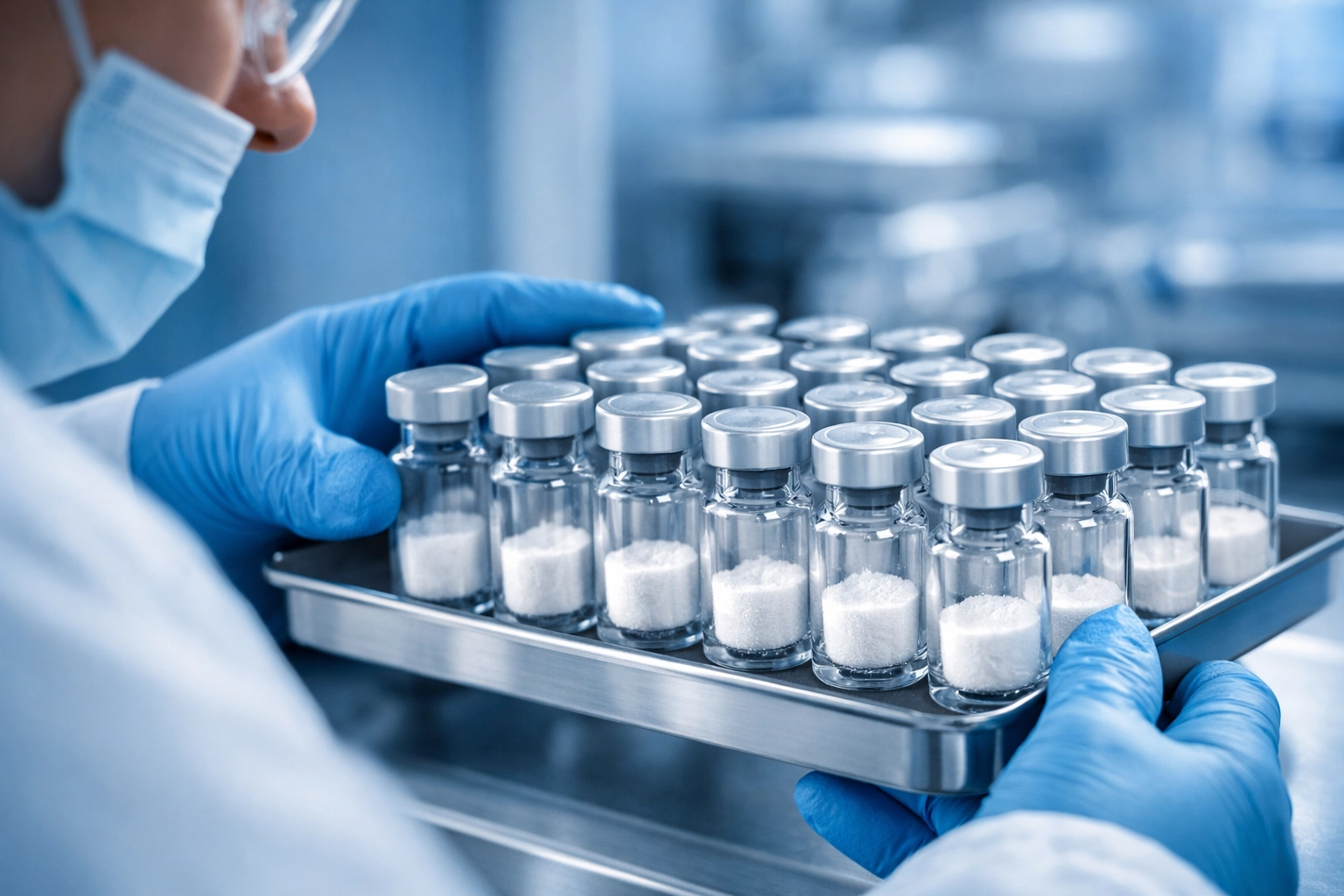 A high-tech laboratory setting illuminated in clinical blue, showing a technician in professional attire verifying a batch of peptide vials for quality control.
Why Is Purity the Absolute Benchmark for Clinical Success?
When discussing peptide therapy, purity is not merely a marketing term; it is a fundamental requirement for patient safety and metabolic predictability. A peptide that is only 80% or 90% pure contains 10% to 20% "unknowns," which are often manufacturing byproducts, residual solvents, or truncated sequences that can trigger unwanted immune responses or systemic inflammation. To achieve consistent results with compounds like BPC-157 or Thymosin Alpha-1 , the purity level must exceed the 99% threshold. This high level of refinement ensures that the ligand-receptor interaction is precise and that the biological signal intended by the clinician is the only one being transmitted to the patient's cells.
Moreover, the verification of this purity must be handled by independent, third-party laboratories using High-Performance Liquid Chromatography (HPLC) and Mass Spectrometry (MS). A Certificate of Analysis (COA) is the only document that provides an objective window into the vial's contents, showing the exact mass of the peptide and the absence of heavy metals or bacterial endotoxins. Many providers are surprised to learn that international suppliers often provide "template" COAs that do not correspond to the actual batch being shipped. Consequently, domestic sourcing from entities that provide batch-specific, verifiable COAs has become the gold standard for practitioners who value their clinical reputation and their patients' well-being.
What Are the Critical Advantages of USA-Made Peptides?
The decision to source peptides manufactured within the United States involves more than just a preference for domestic business; it is a strategic move to ensure supply chain integrity and chemical stability. Peptides are notoriously fragile molecules, susceptible to degradation from heat, light, and physical agitation during transit. When compounds are shipped from overseas, they are often subjected to fluctuating temperatures in non-climate-controlled cargo holds for weeks at a time. In contrast, USA-made products from Biomed Peptides benefit from localized manufacturing and rapid, 2-day shipping, which maintains the structural integrity of the lyophilized powder and ensures maximum potency upon arrival.
Additionally, domestic manufacturing allows for greater transparency and accountability regarding the Raw Active Pharmaceutical Ingredients (APIs) used in the synthesis process. Overseas labs frequently utilize lower-grade reagents to cut costs, which can result in residual TFA (Trifluoroacetic acid) levels that are unacceptable for clinical applications. By keeping the synthesis process within the United States, manufacturers can adhere to more stringent quality control protocols that align with Western medical standards. This proximity also facilitates better communication between the provider and the supplier, allowing for faster resolution of technical questions and a more collaborative relationship in the evolving field of peptide science.
 An abstract representation of a molecular chain in clinical blue tones, symbolizing the 99% purity and structural integrity of USA-manufactured peptides.
Can Small Clinics Benefit from Wholesale Pricing Without High MOQs?
One of the most significant barriers for independent clinics and solo practitioners has historically been the requirement for large Minimum Order Quantities (MOQs) to access wholesale pricing. Many distributors favor large hospital groups or massive wellness franchises, leaving the small clinic to pay retail prices that erode their margins. However, the 2026 market has seen a disruption in this model, with Biomed Peptides offering wholesale pricing that is consistently $20 to $30 lower per vial than major competitors, without the burden of an MOQ. This democratization of access allows smaller facilities to maintain a lean inventory while still enjoying the financial benefits of a large-scale operation.
Furthermore, the ability to order exactly what is needed: whether it is a single vial of Cagrilintide or a variety of metabolic catalysts like 5-Amino-1MQ : enables better cash flow management for the clinic. This flexibility is essential when integrating new protocols or conducting small-scale clinical observations. By removing the financial "red tape" of forced bulk purchasing, healthcare providers can focus their resources on patient care and advanced diagnostic testing. This paradigm shift ensures that high-quality peptide therapy is not just a luxury for large institutions but a viable tool for every qualified healthcare professional.
How Does NPI-Only Access Simplify the Procurement Process?
The traditional pharmaceutical procurement process is often bogged down by a complex web of prescriptions, prior authorizations, and intermediary pharmacies. For the modern clinician focusing on research-based applications or optimized wellness, this process is frequently unnecessary and counterproductive. NPI-only access provides a streamlined alternative where the provider’s professional credentials serve as the primary validation for purchase. This "direct-to-provider" model ensures that only qualified healthcare professionals can access high-purity compounds like PNC-27 or Hexarelin , maintaining a closed-loop system of professional accountability.
Additionally, this method of sourcing allows for a more direct relationship between the manufacturer and the clinician, bypassing the delays often associated with traditional compounding pharmacies. When a provider creates an account using their NPI, they gain immediate access to a professional catalog with transparent pricing and real-time inventory levels. This efficiency is particularly valuable in a fast-paced clinical setting where treatment timelines are critical. By leveraging NPI-only access, clinics can significantly reduce their administrative overhead while ensuring they are sourcing from a compliant and professional entity that understands the specific needs of the healthcare community.
 A digital interface on a modern tablet showing a professional dashboard for peptide ordering, highlighting NPI verification and clinical blue design elements.
Why Is Reliable 2-Day Shipping Essential for Clinical Operations?
In the realm of peptide therapy, timing is often as important as the compound itself. Many clinical protocols, such as those discussed in integrating peptide therapy with hormone optimization , rely on precise scheduling and consistent administration. A delay in the supply chain can disrupt a patient's progress and complicate the interpretation of clinical data. Reliable 2-day shipping acts as a safeguard against these disruptions, providing the clinic with the confidence to schedule follow-ups and start dates with precision. This speed is especially critical for lyophilized products which, although stable at room temperature in a vacuum-sealed state, benefit from minimal time spent in transit.
Specifically, the predictability of a domestic shipping partner allows clinics to operate with a "just-in-time" inventory model. This reduces the need for large on-site storage facilities and ensures that the peptides being used are always from the most recent production batches. Furthermore, fast shipping combined with high-quality packaging protects the vials from the physical stresses of the logistics network. For specialized applications such as medical esthetics and GHK-Cu , having a fresh supply is paramount to achieving the vibrant, revitalized results that patients expect in 2026.
 A map of the United States with glowing blue light trails emanating from a central hub to various cities, representing the speed and reliability of 2-day domestic shipping.
Conclusion: Transforming Your Practice Through Strategic Sourcing
The path to a successful and compliant peptide practice in 2026 is paved with strategic decisions regarding sourcing, purity, and supply chain efficiency. By moving away from the high-friction models of the past and embracing streamlined, NPI-validated procurement, healthcare providers can reclaim their time and focus on the transformative potential of these compounds. Sourcing from a USA-based manufacturer that offers 99%+ purity, transparent COAs, and competitive wholesale pricing without the burden of MOQs is no longer just an option: it is a necessity for clinical excellence.
As we look toward the future of pharmaceutical innovation, the integration of peptides into standard care protocols will only continue to grow. Those who establish a foundation of quality and reliability today will be the leaders of the healthcare landscape tomorrow. The promise of peptide therapy lies in its precision, and that precision begins with the very first vial sourced for your practice. By choosing excellence over convenience and transparency over "red tape," clinicians can ensure that the transition to advanced regenerative medicine is as seamless as it is effective. The future of medicine is here, and it is defined by the high-purity, expertly sourced compounds that are now within reach for every dedicated healthcare professional.